Meal Planning Series
What a Personalized 7 Day Plan Actually Looks LikeAnd how it differs from the generic diet plan you have already tried
You already know that diets fail. What is less obvious is where they fail: not at the nutrition, which is usually fine, but at Tuesday. Here is what a week built around your allergies, your cravings, your schedule and your gut looks like on paper, with the sample days and the grocery list to match.
Part One
A diet is a map. A plan is directions.
A generic diet plan answers a general question: what should a person eat. It is built for an average human who does not exist, and it is usually right about the food. Two cups of vegetables, a lean protein, a whole grain. Nobody is arguing with that.
A personalized plan answers a much narrower question: what should you eat, this week, given the week you actually have. It knows the peanut in the house is a problem. It knows Thursday runs late. It knows you will not eat lentils four nights running no matter how well they score.
Think of the difference as a map against a set of directions. A map of South Florida is completely accurate and completely useless when you are standing at one specific intersection at six in the evening with a car full of groceries. Directions start from where you are. They assume the traffic. They tell you the next turn and nothing else, and that is exactly why you follow them.
Most diet plans hand you the map and call it guidance. The plan then fails, and the failure gets filed under willpower. It was a routing problem.
Part Two
The same meal does not do the same thing to two people
Before any of the practical arguments there is a physiological one. Identical food, eaten by different people, produces very different responses in the blood.
How much responses varied between people eating identical meals
Coefficient of variation between individuals in PREDICT 1, which gave standardized test meals to 1,002 adults. Higher means more spread between people.
Exact published values rather than a scaled illustration. Bars are scaled against the largest of the three. Source: Berry and colleagues, Human postprandial responses to food and potential for precision nutrition, Nature Medicine, 2020.
The interesting part is what explains that spread. In the same study the meal itself accounted for only about 15% of the variation in glucose response, and genetics for under 10%. Gut microbiome composition accounted for a further 6%. Most of the variation came from person specific factors that a printed diet sheet has no way of seeing.
An earlier Israeli study arrived at the same place from a different direction. Researchers tracked continuous glucose in 800 people and found that responses to identical foods differed enough that standard glycemic rankings were a poor guide for any given individual. A small blinded crossover that followed, with 26 participants, found that meals chosen by an algorithm trained on personal data lowered post meal glucose more than meals designed by a dietitian and a physician working toward the same goal.
None of this means your body is a puzzle only a laboratory can solve. It means that a plan which adapts to feedback will beat a plan that cannot, and that most of what makes the difference is observable without a single blood draw: what you tolerate, what you like, and when you are actually home.
Part Three
The four inputs that change the week
Personalization is not a mood. It is a short list of specific constraints, and each one rewrites a real part of the plan.
Input 01
Allergies and intolerances
The hard boundary. About 10.8% of US adults have a convincing food allergy, with shellfish, milk and peanut leading the list. A generic plan puts these in a footnote. A personalized one takes them off the shopping list and swaps in something that plays the same role.
You should never have to read a plan defensively.Input 02
Cravings and real preferences
The input most plans treat as a character flaw. If you dislike a food you will stop eating the plan before you stop wanting the food. Preference is not noise to be corrected out. It is the variable that decides whether week two happens at all.
A plan you resent has a very short shelf life.Input 03
Your actual work schedule
Most plans assume seven identical evenings. Yours are not identical. A late Thursday needs a meal that was finished on Sunday, and a slow Saturday can carry the cooking for three other days. The calendar shapes the menu, not the other way around.
The best meal for a hard night is one already made.Input 04
Fiber, variety and your gut
Gut bacteria respond to what arrives, and they respond quickly. What matters most is the range of plants across the whole week rather than the perfection of any one meal, which is why a plan is a better unit of measurement than a recipe.
Count the week, not the plate.Worth being precise about
- An allergy is not a preference
- An allergy is an immune response and can be dangerous. An intolerance causes discomfort without that immune mechanism. Roughly 19% of US adults believe they have a food allergy while about 10.8% have one that meets clinical criteria, which is a good argument for a real diagnosis rather than a guess.
- Variety is measured across days
- No single meal holds enough different plants to matter much on its own. The useful unit is the week, which happens to be the unit a grocery trip already runs on.
- A swap is not a compromise
- Replacing peanut with sunflower seed, or dairy with a fortified plant milk, keeps the structure of a dish intact. The plan does not shrink when a food is removed. It routes around it.
Part Four
How long before you notice
The honest answer arrives in stages, and the first thing that changes is not your body.
Days 1 to 3
The mental load drops before anything else does
The first thing a plan gives back is the nightly negotiation about dinner. Nothing measurable has happened in your bloodwork yet. Meanwhile your gut bacteria have already started responding to the new mix of food, which they do within about a day of it arriving.
Week 1
Digestion adjusts, sometimes noisily
If your fiber intake has jumped, expect some bloating or gas while the bacteria that ferment fiber catch up. This settles. Ramping up across a week rather than overnight makes it milder, and water helps.
Weeks 2 to 6
Energy and appetite start behaving differently
This is the window where people most often report steadier energy through the afternoon and less scavenging at night. In the 18 week trial described below, 43% of the personalized group reported improved energy against 11% of the group following standard guidelines.
Month 3 and beyond
Blood markers move, modestly
Changes in triglycerides, waist circumference and overall diet quality show up on this timescale in controlled trials. They are real and they are moderate. Anyone promising a transformation on this schedule is selling something.
Windows drawn from David and colleagues on rapid microbiome change, Nature, 2014, and from an 18 week randomized trial of a personalized program against standard dietary guidance, Nature Medicine, 2024. Individual timing varies and none of these are guarantees.
Here is the catch, and it is a large one. These changes are rented, not owned. The same research showing gut bacteria shift within a day also shows them drifting back within a couple of days of the food stopping. A good week banks nothing. It only makes the next week easier to run, because the shopping habit and the aisle list are already built.
Part Five
Who gains the most from a plan built this way
Personalization pays off hardest where a generic plan sits furthest from the truth. One gap makes the point better than most.
US adults who meet the daily fiber recommendation
Percentage of adults reaching 14 grams of fiber per 1,000 calories, from national dietary survey data covering more than 14,600 adults.
Exact published values. Bars are scaled against the full population, so the gray bar is the target rather than a finding. Source: analysis of NHANES 2013 to 2018 data presented at NUTRITION 2021, reported by the American Society for Nutrition.
That is the shape of the problem across the board. The generic plan is not wrong. It is written for a person who is already most of the way there.
The households where a personalized week changes the most are the ones carrying an extra constraint. Families cooking around an allergy, where one ingredient rules out half the recipes in a standard plan and nobody wants to make two dinners. Shift workers and anyone with an uneven week, whose evenings are not interchangeable and who get punished by any plan that assumes they are. Students and anyone on a tight grocery budget, for whom a list that prevents a second midweek trip is worth more than any macro target. Parents, managing at least two sets of preferences against a hard deadline every single evening.
Planning itself tracks with better eating, though that evidence is observational rather than causal. In a survey of more than 40,000 French adults, people who planned meals had greater food variety, better adherence to nutrition guidelines and lower odds of obesity. The researchers were careful to note that health conscious people may simply be more likely to plan in the first place.
Part Six
A real week, three of its days, one grocery list
What follows is one household in Sunrise in September: two adults and a nine year old with a peanut allergy, three cooking nights, and one evening that reliably runs late. Nothing here takes longer than about half an hour.
Monday · an ordinary evening
Cook once, eat twice
Morning. Smoothie with mango, spinach, banana, ground flaxseed and oat milk.
Midday. Black bean and sweet corn salad with tomato and lime over greens.
Evening. Sheet pan eggplant, zucchini and bell pepper with chickpeas, cumin and lemon, over rice started at the same moment the oven went on.
The tray is deliberately oversized. Half of it becomes Tuesday, which is the entire reason for cooking on a Monday.
Tuesday · the late meeting
The night the plan is actually for
Morning. The same smoothie base with watermelon instead of mango.
Midday. Cucumber, tomato and white bean salad packed the night before.
Evening. Monday’s roasted vegetables folded into a warm grain bowl with hummus and lemon. Ten minutes, no knife work, no decision.
A generic plan would have assigned Tuesday a fresh recipe with a twenty five minute cook time. That recipe is where the plan dies.
Saturday · market morning
The two hours that carry the week
Morning. Oats with blueberries and sunflower seeds after the market.
Midday. Whatever looked best, sliced, with tortillas.
Evening. Sweet corn and tomato tacos with avocado, lime and a toasted sunflower seed crumble in place of the usual peanut.
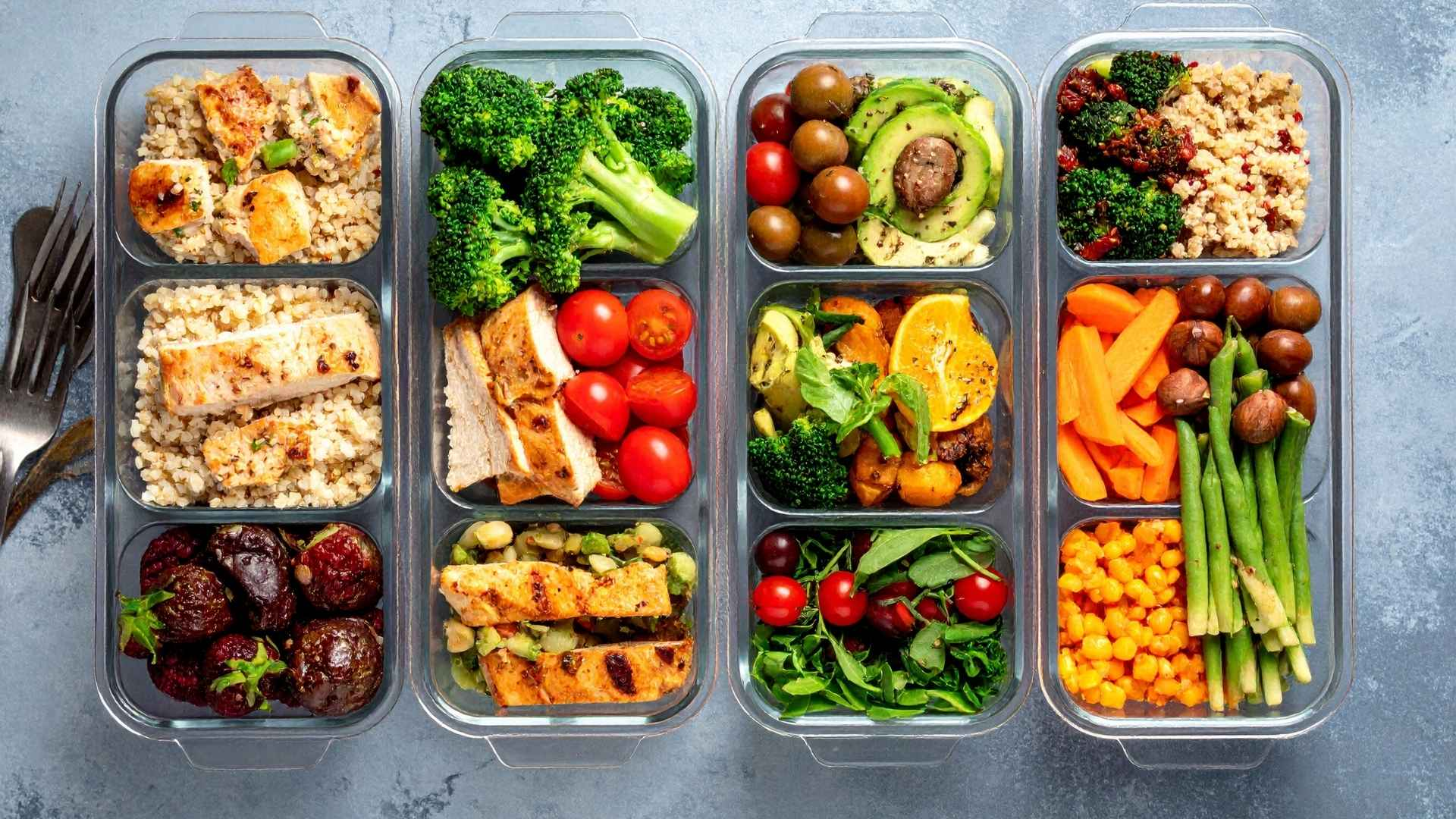
Two trays of vegetables, a pot of beans and a jar of dressing go into the refrigerator before noon. Sunday through Wednesday are now assembly rather than cooking.
An example week, not a prescription. Produce chosen from what is genuinely in season in Florida in September. Source for seasonality: Florida Department of Agriculture and Consumer Services produce availability chart.
The same week, sorted by aisle
- Produce
- Mango, banana, spinach, sweet corn, tomatoes, eggplant, zucchini, bell pepper, cucumber, avocado, watermelon, cilantro, limes, lemons
- Pantry and dry goods
- Black beans, chickpeas, white beans, brown rice, rolled oats, ground flaxseed, sunflower seeds
- Refrigerated
- Oat milk, hummus, firm tofu, salsa
- Frozen
- Blueberries, edamame, peas
- Bakery and tortillas
- Corn tortillas, one loaf of whole grain bread
Sorted the way the store is laid out rather than the way the recipes are written, which is the only reason it can be walked in a single pass. Nothing on this list contains peanut.
Where the week’s plant variety comes from
Count of distinct plant foods in each aisle group of the list above. Shading steps down with the count.
Counted from the sample list above rather than drawn from research. An illustration of how one ordinary week reaches useful variety. Bars are scaled against the largest group.
Add the tortillas and the bread and this week touches roughly 28 distinct plant foods, with no unfamiliar ingredients and no specialty store. That is the practical case for sorting a list by aisle rather than by recipe: the same food, walked in one pass instead of five.
It also cuts what gets thrown away. The USDA puts food waste at roughly 30% to 40% of the US food supply, and the household share of that is largely produce bought without a plan for it. A list written from a week of actual meals has a job waiting for every item on it.
Part Seven
Four rules for keeping it going in a normal week
The plan is the easy part. These four things decide whether it survives past the first hard Thursday.
Rule one
Build the week around the calendar, not the recipes
Open your week first and mark the nights that will not have cooking in them. Assign those nights before you choose a single dish. A plan that ignores your calendar is a plan you will abandon on the night you needed it most.
Rule two
Repeat something on purpose
Eat the same breakfast four days running if it works. Variety comes from the range of plants across the plan, not from novelty at every meal. Repetition is what keeps the shopping list short and the mornings automatic.
Rule three
Swap within the aisle, never out of the plan
If the zucchini looks tired, buy the squash beside it. If mango is finished for the season, take the pineapple. The structure of the week survives any substitution made in the same aisle, and it collapses the moment you decide to start the whole thing over.
Rule four
Shop the season you are actually in
South Florida runs on a different calendar than most published produce charts, which assume a northern growing year. Our main harvest runs roughly October through May, leafy greens land around December to April, and tropical fruit carries the summer. Buying with that calendar is cheaper, fresher and far easier than fighting it.
Part Eight
About what this can and cannot do
Worth saying plainly
Personalization earns its keep through fit, not by decoding you
The strongest evidence for personalized eating comes from short randomized trials and large observational cohorts. The 18 week trial cited above did find better triglycerides, waist measurement, diet quality and self reported energy in the personalized group. It also found no difference in LDL cholesterol, and the weight change sat below the 5% threshold usually treated as clinically meaningful. The personalized group received more contact with the program than the control group did, which is a real confound the authors named themselves.
The complicating findings deserve equal billing. In the pan European Food4Me trial, personalized advice beat generic guidance across 1,607 participants, but adding blood biomarkers and genetic testing on top of it added nothing measurable. In the DIETFITS trial, 609 adults followed either a low fat or a low carbohydrate diet for a year and lost about the same amount on average, with enormous variation between individuals, and neither genotype pattern nor baseline insulin secretion predicted who would do well on which. The honest reading is that personalization works mainly because it produces a plan you can actually follow, not because it decodes something hidden in your biology.
If you have a diagnosed allergy, diabetes, kidney disease, a history of disordered eating, or you are pregnant or taking medication that interacts with food, a plan from any service is the start of a conversation with your clinician or a registered dietitian rather than a replacement for one. What you can do this week without hesitation costs nothing and needs no testing: write down the seven days you actually have before you write down what you are going to eat.
Food is the first medicine.
Get your free 3 day planSources
- Nature Medicine · Human postprandial responses to food and potential for precision nutrition
- Cell · Personalized nutrition by prediction of glycemic responses
- Nature Medicine · Effects of a personalized nutrition program on cardiometabolic health: a randomized controlled trial
- International Journal of Epidemiology · Effect of personalized nutrition on health related behaviour change: evidence from the Food4Me European randomized controlled trial
- JAMA · Effect of low fat vs low carbohydrate diet on 12 month weight loss and the association with genotype pattern or insulin secretion: the DIETFITS randomized clinical trial
- JAMA Network Open · Prevalence and severity of food allergies among US adults
- Nature · Diet rapidly and reproducibly alters the human gut microbiome
- American Society for Nutrition · Most Americans are not getting enough fiber in our diets
- International Journal of Behavioral Nutrition and Physical Activity · Meal planning is associated with food variety, diet quality and body weight status in a large sample of French adults
- US Department of Agriculture · Food waste frequently asked questions
- Florida Department of Agriculture and Consumer Services · Florida produce seasonal availability chart